
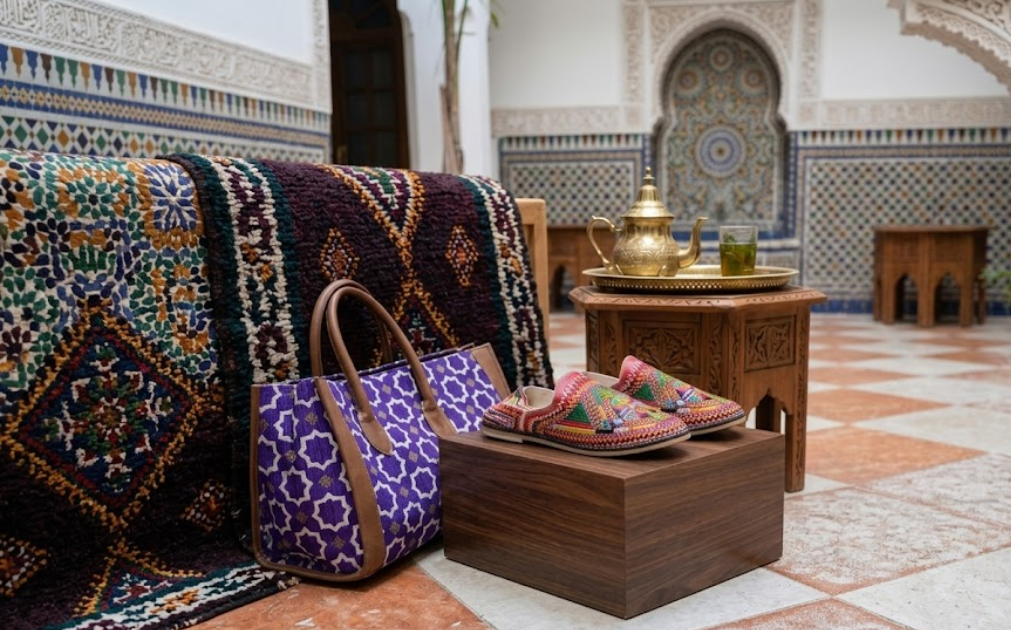
Babouche shoes are flat, backless leather mules handcrafted by artisan Maalems in Fes, Morocco. Each pair passes through a full chain of hands: tanners, cutters, stitchers, embroiderers, using techniques that have not changed in centuries. As slow fashion replaces fast footwear, the babouche is having a genuine moment. Not because it changed, but because the world finally caught up to what handmade leather shoes were always supposed to be.
At Kilimy, every babouche in our leather collection is sourced from verified artisans in Fes and carries an Origin Passport, a traceable provenance record confirming the maker, the city, and the craft tradition behind your pair. Shop the leather collection.
Fashion has spent decades stuck between two camps. One preaches beauty at any cost: heels that maim, silhouettes that suffocate. The other fought back just as hard, a wave of sneaker culture and "ugly shoe" rebellions insisting comfort should win, even if it means giving up on looking good.
Somewhere between these two extremes, a shoe has been quietly waiting. Handmade, centuries old, and worn without complaint by generations of Moroccans long before either camp picked a side. The babouche never had to choose. And now, as the world rediscovers slow fashion and handmade goods, it is finally having its moment.
What Babouche Shoes Are, and Why They Are Genuinely Handmade
A babouche is a flat, backless leather shoe, part slipper, part mule, worn across Morocco for centuries as everyday footwear and offered to guests as a gesture of welcome. Each pair is shaped by up to a dozen artisan hands: tanners, cutters, stitchers, embroiderers, and master craftsmen called Maalems. Nothing about a real babouche touches a machine. That is what "handmade leather shoes" was always supposed to mean.
The name changes with the region. A Fassi Belgha looks different from a Rabati Cherbil, which looks different again from a Soussi Idoukan. But the shape only tells you half the story. It does not tell you the labor behind it, or the years it took each artisan to earn the title of Maalem in the first place.
Most of what gets called "handmade" today just means a machine did the work and a person touched it once at the end. A babouche does not work that way. It passes through a full chain of hands before it is ready to wear, each artisan trained by someone who was trained the exact same way decades before them. A babouche is not a shoe with a story attached to it for marketing purposes. It is a shoe that literally could not exist without one.
Why Handmade Leather Shoes Are Having a Real Moment Right Now
This is not nostalgia. It is a correction.
For years, "more" was the entire strategy: more colorways, more drops, more units shipped faster than anyone could actually wear them out. People are tired of it. There is a growing, very deliberate rejection of fast fashion happening right now, and it is showing up in what people choose to put on their feet. Artisan footwear, made by hand, built to last, traceable to a named maker, is winning back ground that mass production spent decades taking.
Durability that fast fashion cannot fake. Machine-stitched synthetic shoes are built to be replaced. Hand-tanned, hand-stitched leather is built to be resoled, reworn, and passed down. The best babouches outlast a dozen pairs of fast-fashion alternatives.
Uniqueness you cannot scale. No two hand-embroidered pairs are identical. When everyone's shoe closet looks the same, a piece that is slightly different every time becomes the actual flex.
A visible human hand. People want to know a real person made the thing they are wearing. Not "designed by," but made by. That distinction matters more every year, not less. Ethical leather shoes are not a niche preference; they are becoming the standard for anyone paying attention.
Slow fashion as a value, not a trend. The buyers choosing artisan footwear in 2026 are not doing it to be on-trend. They are doing it because fast fashion's environmental and human cost is no longer something they are willing to ignore.
The babouche was never trying to catch this wave. It has been standing in the same place the whole time, waiting for everyone else to walk back toward it.
Origin-Proof: Where Moroccan Babouche Shoes Actually Come From
Fes, Morocco. The Dar Dbagh tannery quarter. Verified by Kilimy's Origin Passport.
If you want the real thing, you need to know where it starts.
Fes is home to the Dar Dbagh, one of the oldest working tannery complexes in the world, still operating the way it has for centuries: stone vats, natural dyes, leather worked by hand from raw hide to finished material before it ever reaches a cutting table. This is not a curated tourist backdrop. It is a working tradition, passed down through families of tanners, where the leather for a real Moroccan babouche begins its life.
From there, the leather moves to the Maalems, the master artisans who cut, shape, stitch, and embroider each pair. Every babouche in Kilimy's leather collection is made by Mohamed A., a verified Fes leather artisan whose work is traceable through our Origin Passport system. This is the part that gets skipped in most "artisan-inspired" products on the market: a real babouche is not inspired by this process, it is the direct product of it. Every pair traces back to that same chain: tannery to Maalem to your feet, with nothing manufactured in between.
The Origin Passport means you are not taking our word for it. The maker, the city, and the craft tradition are documented and verifiable, because a claim without proof is just marketing copy.
What to Look for in Authentic Moroccan Leather Shoes
Not every babouche on the internet is what it claims to be. Here is how to verify authentic handmade leather shoes before you buy.
The smell and feel of the leather. Real vegetable-tanned or naturally tanned leather has a distinct, slightly earthy smell, not the sharp chemical scent of synthetic or heavily processed material. It should feel supple, not stiff or plasticky.
The sole construction. Authentic babouche shoes use a stitched or hand-built leather sole, often layered for durability. A glued, uniform rubber sole is a shortcut, not a tradition.
Uneven, natural dyeing. Hand-dyed leather carries small variations in tone. If every pair in a "handmade" collection looks perfectly identical, machines were involved somewhere in the process.
Visible hand-stitching. Look closely at the seams and embroidery. Slight irregularity is a feature, not a flaw. It is proof a human hand, not a machine arm, did the work.
Weight and structure. Real leather babouches have a certain heft and shape memory. Cheap synthetic versions feel hollow and bounce back into shape too quickly.
Provenance you can verify. If a seller cannot tell you where the leather was tanned, which city the artisan works in, or who made the shoe, that is the answer right there. A verified artisan footwear brand can name its makers. An unverified one can only say "handmade in Morocco."
How to Wear Moroccan Babouche Shoes in a Modern Wardrobe
Babouche shoes have already quietly slipped into modern styling. Most people just have not clocked it yet.
At home: Swap the tired slide-sandal-and-sweatpants combination for a pair of soft leather babouches with linen trousers and an oversized shirt. It is the easiest upgrade to a considered, design-conscious home aesthetic that exists.
Out and about: A structured leather babouche with a slight pointed toe works with wide-leg trousers or a midi skirt exactly the way a loafer or mule would, minus the mass-produced sameness. Pair a rounded, casual style with denim and a simple tee for an effortless, understated look.
Travel and transitional weather: Babouches pack flat, weigh almost nothing, and work barefoot or with thin socks, making them one of the smartest handmade leather shoes to pack in a carry-on.
The common thread: babouche shoes do not compete for attention, they anchor an outfit. That is exactly why stylists and quiet-luxury dressers keep circling back to them.
Why Babouches Make a Genuinely Meaningful Handmade Gift
Most gifts say "I bought something." A babouche says "I bought something someone made."
Because each pair moves through Fes tanners and Maalem artisans by hand, no two are perfectly identical, which means the gift itself carries a story worth telling at the moment it is unwrapped. It is not a gift that gets returned or forgotten in a closet. It is a gift that gets worn in, that ages with the person, and that carries an actual place and an actual craft tradition behind it.
For weddings, housewarmings, milestone birthdays, or "I saw this and thought of you" moments, babouches hit a rare sweet spot: personal, useful, and genuinely rare. The $40 to $120 price range makes them one of the strongest value propositions in the handmade gift category, more meaningful than anything on Etsy's front page, and traceable in a way no mass-market alternative can match.
Frequently Asked Questions About Babouche Shoes
What is a babouche shoe?
A babouche is a traditional Moroccan leather shoe, flat and backless, worn as everyday footwear across Morocco for centuries. It sits between a slipper and a mule in construction and is made entirely by hand by artisan craftsmen called Maalems. Babouches come in pointed-toe and rounded-toe styles, in natural leather and embroidered versions, and are suitable for both indoor and light outdoor wear depending on the sole construction.
Where do babouche shoes come from?
The finest babouche shoes come from Fes, Morocco, where the Dar Dbagh tannery quarter has produced leather for centuries using stone vats, natural dyes, and techniques passed down through generations of tanners. From the tannery, the leather moves to Maalem artisans who cut, stitch, shape, and embroider each pair by hand. Kilimy sources every babouche in its leather collection from verified Fes artisans, traceable through the Origin Passport provenance system.
Are babouches comfortable?
Yes, once the leather softens with the first few wears. Real leather molds to your foot over time rather than fighting it the way synthetic materials do. The break-in period is short, usually just a few wears, after which a well-made babouche conforms to the shape of your foot.
Do babouche shoes run true to size?
Most babouches run close to true to size, though many people find sizing down slightly is better since the leather stretches and relaxes with wear. Checking the specific size guide for your pair is always the safest approach.
How do I care for leather babouche shoes?
Keep them away from prolonged water exposure. Condition the leather every few months with a natural leather balm. Let them air out between wears rather than storing them immediately after taking them off. Treated this way, a good pair of handmade leather babouches easily lasts several years.
Can babouches be worn outdoors?
Yes. Sturdier styles with reinforced soles are built for outdoor wear. Softer, lighter styles are better suited to indoor or short outdoor use. Check the sole construction before buying if outdoor use is your priority.
What is an Origin Passport and does it apply to babouche shoes?
An Origin Passport is Kilimy's provenance verification system. Every product that carries one is traceable to a named artisan in a confirmed Moroccan city, verified before it goes live on the site. For babouches, this means the leather source (Fes, Dar Dbagh tannery quarter), the artisan's name, and the craft tradition are all documented and verifiable, not marketing language.
Where do Kilimy's babouche shoes ship to?
Kilimy ships to the United States, United Kingdom, Belgium, Portugal, Spain, and Europe via DHL Express. Orders include tracking from dispatch. For current delivery estimates and shipping costs by country, see the leather collection page.
Ready to Feel the Difference in Verified Handmade Leather?
Once you have felt what actual hand-tanned, hand-stitched leather feels like against your foot, it is hard to go back to anything mass-produced. Every babouche in Kilimy's leather collection is traceable back to Fes, back to the Maalems who made it, back to a tradition that was never trying to trend. It just always knew what it was doing.
Shop handmade Moroccan leather shoes →
Looking for more verified Moroccan craft? Explore the full Kilimy artisan marketplace, six cities, verified makers, and an Origin Passport on every piece.